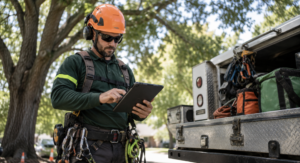
An arborist’s work will always require sharp tools, steady hands, specialized knowledge, and a healthy respect for gravity. Chainsaws, climbing ropes, aerial lifts, wood chippers, and protective equipment remain central to the profession. Yet another collection of tools has quietly become just as important to the success of a modern tree care business.
Those tools are digital. 🌳💻
Information technology now affects nearly every part of an arborist’s operation, from receiving the first customer inquiry to documenting the final cleanup. Scheduling software keeps crews moving. Mobile applications deliver job details to workers in the field. Cloud storage protects inspection reports and customer records. Mapping technology helps companies locate trees, plan routes, and document hazardous conditions. Cybersecurity protects the business from threats that cannot be removed with a pruning saw.
For arborists competing in crowded local markets, IT is no longer an optional office convenience. It is part of the equipment needed to operate efficiently, communicate professionally, protect sensitive information, and build a company capable of growing without becoming disorganized.
IT Has Become Part of the Arborist’s Everyday Work
The term information technology covers the systems used to create, process, store, exchange, and protect electronic information. That definition may sound far removed from removing storm-damaged branches or inspecting a declining oak, but the connection becomes obvious when examining an arborist’s daily responsibilities.
Customer contact information, property addresses, estimates, photographs, inspection notes, invoices, permits, crew assignments, equipment records, and payment details all exist as business data. Even a small arborist company may handle hundreds or thousands of digital records during a year. Without a dependable system, those records become scattered across personal phones, handwritten notebooks, email inboxes, text messages, and office computers.
A missed message can become a lost job. An outdated address can send an expensive crew to the wrong property. A missing photograph can create confusion during an insurance claim. An estimate that remains buried in an inbox may allow a competitor to win the project.
Technology reporting from sources such as Ars Technica’s Biz and IT section regularly illustrates how deeply software, security, cloud infrastructure, and connected devices have entered ordinary business operations. Arboriculture is no exception. The work may happen outdoors, but the business supporting that work increasingly depends on reliable digital systems.
Scheduling Software Keeps Crews and Customers Moving
Scheduling is one of the clearest areas where IT can improve an arborist’s business. Tree care projects rarely follow a perfectly predictable timetable. A removal may take longer than expected. A storm may create emergency calls. Equipment may require repair. Rain, wind, lightning, or saturated ground may force a job to be postponed.
A paper calendar cannot automatically notify customers, update crew members, adjust route plans, or attach job instructions. Modern scheduling software can.
A centralized system allows office staff, estimators, crew leaders, and business owners to view the same information. When a project changes, everyone can see the update without relying on a chain of phone calls and text messages. Job records can include the property address, customer contact information, service description, access concerns, photographs, equipment requirements, and safety notes.
Cloud-based customer relationship management platforms can also track each potential job from the first call through estimate approval, scheduling, completion, invoicing, and follow-up. TechCrunch’s enterprise technology coverage frequently reports on the expanding market for software that helps organizations manage customers, workflows, communications, and operations. These tools are not limited to large corporations. Smaller service companies can use similar technology to create a more organized customer experience.
The result is not simply a cleaner calendar. It is a business that responds faster, makes fewer avoidable mistakes, and presents a more professional image to customers.
Mobile Technology Connects the Office to the Treetop
An arborist’s workplace changes throughout the day. Crews may begin at the shop, travel to several properties, visit a disposal site, pick up supplies, and return equipment before heading home. Important decisions are made far from a traditional office.
Mobile technology closes the distance between the field and the people managing the business.
Crew leaders can use tablets or smartphones to review work orders, document tree conditions, capture before-and-after photographs, record materials, collect customer signatures, and mark projects complete. Estimators can build proposals while standing on the property instead of returning to the office and trying to reconstruct their notes later.
This immediate flow of information can reduce delays. Office staff can prepare an invoice soon after work is completed. Managers can determine whether another crew should be sent to assist. Customers can receive updates without repeatedly calling for information.
Mobile access is especially valuable during storm response. When multiple calls arrive within a short period, a shared system can help categorize emergencies, identify blocked access routes, assign available crews, and preserve accurate records of each response. The company gains a clearer view of the situation while customers receive more consistent communication during a stressful event.
Digital Mapping Gives Arborists a Better View of the Work
Tree care is naturally connected to location. Every inspection, pruning project, hazard assessment, preservation plan, and removal occurs at a specific place. Geographic information systems, satellite imagery, digital maps, and GPS-enabled devices can turn location into useful operational data.
An arborist can use mapping tools to mark individual trees, record species, note structural concerns, attach photographs, and document recommended maintenance. Municipal contractors and consulting arborists may use these records to support tree inventories, risk assessments, construction planning, and long-term canopy management.
Commercial tree care companies can use mapping to plan more efficient driving routes and reduce unnecessary fuel consumption. They can also identify clusters of customers within a neighborhood and coordinate projects more effectively.
Digital maps are particularly helpful when a property contains numerous trees or when several decision-makers are involved. A numbered tree on a map is easier to discuss than a vague description such as the large tree near the back fence. Better documentation reduces misunderstandings and creates a clearer record of the arborist’s observations and recommendations.
Over time, this information becomes more valuable. The company can review previous inspections, compare photographs, track changes in tree condition, and demonstrate the history of professional care provided at the property.
Cybersecurity Protects More Than Office Computers
A tree care company may not consider itself a likely target for cybercrime, but its systems can contain customer addresses, employee information, banking details, tax documents, contracts, passwords, and payment records. That information has value, regardless of whether the company has five employees or five hundred.
Cybersecurity begins with practical safeguards. Devices should receive software updates. Business accounts should use strong, unique passwords and multifactor authentication. Employees should understand how to recognize suspicious links, fake invoices, and fraudulent password requests. Important files should be backed up in a secure location that is not dependent on a single office computer.
The NIST Cybersecurity Framework 2.0 provides guidance that organizations can use to understand and manage cybersecurity risks. Its approach emphasizes governance, identification, protection, detection, response, and recovery. Those principles can help an arborist company create a practical security plan rather than waiting until a breach or equipment failure causes disruption.
The Cybersecurity and Infrastructure Security Agency’s small-business resources also provide guidance for companies that may not employ a full internal security department. CISA highlights measures such as backups, encryption, logging, secure cloud services, and stronger account protection.
Cybersecurity news changes quickly, so arborist companies should also follow dependable sources such as the Microsoft Security Blog to stay aware of new threats and protective practices. A company does not need to become a cybersecurity laboratory, but it does need to maintain its digital equipment with the same seriousness applied to vehicles, climbing gear, and cutting tools.
IT Helps Customers Find and Trust the Business
The first interaction between a customer and an arborist often happens online. A homeowner may begin by searching for an Arborist Near Me, reviewing local listings, comparing websites, reading customer feedback, and looking for evidence that the company is qualified and dependable.
A strong online presence depends on more than launching a website and forgetting about it. Business information must remain accurate across search engines and directories. The site should load properly on mobile devices, use secure connections, explain services clearly, and make it easy for visitors to call or request an estimate.
IT also supports the systems behind that website. Contact forms must deliver messages to the correct inbox. Phone tracking needs to work accurately. Customer inquiries should enter a follow-up process instead of disappearing after the first response. Analytics can reveal which service pages attract visitors and which areas generate the most calls.
Photographs, credentials, educational content, project details, and clear service information can help establish trust before a customer ever speaks with the company. In a profession where safety, property protection, and technical judgment matter, that early credibility can strongly influence who receives the call.
Technology cannot replace a certified, experienced arborist. It can make that expertise easier for the public to discover, understand, and verify.
Better Data Leads to Better Business Decisions
Many arborist companies make decisions based on experience, instinct, and memory. Those qualities remain valuable, but dependable data can reveal patterns that memory overlooks.
Business software can show which services generate the strongest revenue, which neighborhoods produce repeat work, how long estimates remain open, and how frequently approved jobs are delayed. It can reveal whether a particular crew consistently completes work ahead of schedule or whether one category of project regularly requires more labor than estimated.
Equipment data can help managers track repairs, inspections, operating hours, and replacement schedules. Vehicle records can support preventative maintenance. Inventory systems can monitor supplies and reduce last-minute trips for fuel, chains, safety equipment, or replacement parts.
Financial information becomes more useful when it is connected to operations. An arborist may discover that a service appears profitable until disposal fees, travel time, equipment wear, and additional labor are included. Accurate records allow pricing to reflect the true cost of completing the work safely.
Data also improves planning. A company can compare seasonal demand, prepare for storm periods, identify slow months, and determine when hiring or purchasing another vehicle is financially reasonable. Instead of making every decision under pressure, the owner gains a clearer picture of where the business has been and where it is heading.
Automation Can Handle Repetition Without Replacing Expertise
Automation is most useful when it removes repetitive administrative work. Appointment reminders can be sent automatically. Estimate follow-ups can be scheduled. Customers can receive preparation instructions before a crew arrives and care information after a project is completed.
Invoices can be generated from completed work orders. Inspection dates can trigger future reminders. Customer records can be updated without entering the same information into several separate programs.
Artificial intelligence is adding another layer to these capabilities. Current reporting from MIT Technology Review demonstrates how quickly AI is moving into business workflows, analysis, communication, and decision support. For an arborist company, AI may assist with organizing notes, summarizing inspection records, drafting routine communications, categorizing photographs, or reviewing operational data.
These tools should support professional judgment rather than imitate it. Software cannot feel decay hidden behind bark, evaluate a complex load path from a photograph alone, or replace the responsibility of a qualified arborist standing at the tree. The strongest use of technology is to give the professional better information, cleaner records, and more time to focus on work requiring actual expertise.
The Right IT Strategy Should Fit the Arborist
Buying every available application can create more confusion than progress. A successful IT strategy begins with the company’s real operational problems.
A small residential tree service may need dependable scheduling, digital estimates, cloud file storage, online payments, and secure email. A larger operation may require fleet tracking, advanced job costing, inventory management, customer relationship software, and integrations between several departments. A consulting arborist may place greater emphasis on field data collection, mapping, photography, document management, and report production.
The systems should work together whenever possible. Requiring employees to enter the same customer information into several unrelated platforms wastes time and increases the possibility of mistakes. Technology should simplify the workflow, not create a second job devoted to managing the software.
Training matters as much as the product itself. Even an excellent platform will fail when employees do not understand how or why to use it. Clear procedures, realistic expectations, and ongoing support help turn a software purchase into an actual improvement.
Conclusion
The chainsaw will remain one of the most recognizable tools in arboriculture, but it is no longer the only tool capable of shaping an arborist’s future.
Information technology helps tree care companies schedule crews, communicate with customers, document conditions, secure business records, track equipment, improve marketing, analyze performance, and prepare for growth. It connects the office to the field and transforms scattered information into a system the entire company can use.
The arborist who combines field expertise with reliable technology gains an important advantage. The work becomes more organized. Customers receive clearer communication. Employees have better information. Business owners can make decisions with greater confidence.
The modern arborist’s secret weapon is not a louder saw or a taller lift. It is an IT system working quietly behind the scenes, making every truck, crew, customer interaction, and business decision more effective. 🌲
